


I gave this talk at the Kingston Employment & Skills Summit on Wednesday. The room was full of employment advisers, housing officers, DWP staff, community workers, and council leads. This is a lightly edited version of what I said.
I’m Dom, I run Stay Nimble, and we’ve been working in Kingston since 2022. Some of you reading this will have referred people to us, some of you will have heard the name, some of you might be hearing about us for the first time. We’re a tech social enterprise that has been helping thousands of people across the UK with career transitions since 2018.
I’ve been asked to talk about the AI shift. And there’s a lot of noise around this right now, lots of predictions, lots of analysis, lots of opinions.
I’m going to do my best to resist that and not only talk about a future that might happen. I’m going to focus on what we’ve already built in Kingston in partnership with the council, what years of evidence tells us, and three things you can actually do.
The endemic question
Before I get into what we’ve built, I want to put a question in front of you, because it’s the question that’s been on my mind for a while now.
What if this isn’t a wave to ride out? What if it leads to a permanent change in how often people need to change direction?
Because I think the answer to that question changes how we need to respond now to offset potential risks of significant disruption. And I think it might change what some of the roles in this sector look like, too.
The AI shift
So let me start with what the AI shift means to me.
Career transitions, job loss, redundancy, people not knowing what to do next. We’ve been dealing with this for over a hundred years, since the first labour exchanges. It’s not new. It’s not a new crisis. It’s endemic. It’s a permanent feature of working life.
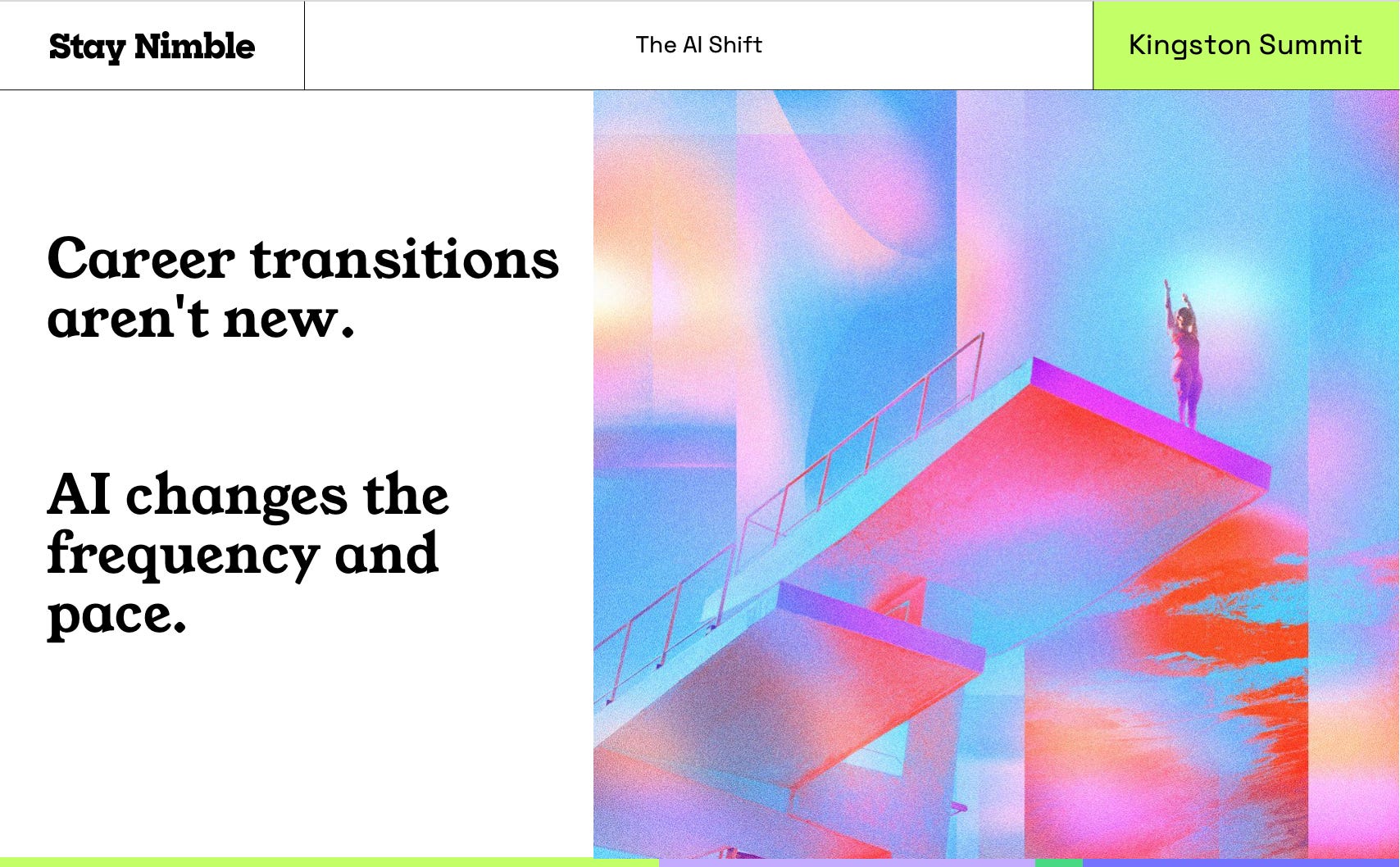
What AI is likely to change is the frequency and the pace of those transitions. And I want to be careful here, because the headlines would have you believe we’re heading for mass unemployment. The evidence doesn’t support that yet.
What the evidence tells us
What we are seeing is disruption. And I want to be upfront about these numbers, because the picture is complicated.
Firms with high AI exposure have reduced junior positions by nearly 6%. UK job adverts fell 38% in AI-exposed occupations between 2022 and 2025, compared to 21% in less exposed roles. And I think that the 21% is actually what matters most. A 21% fall in roles that aren’t even directly exposed to AI.
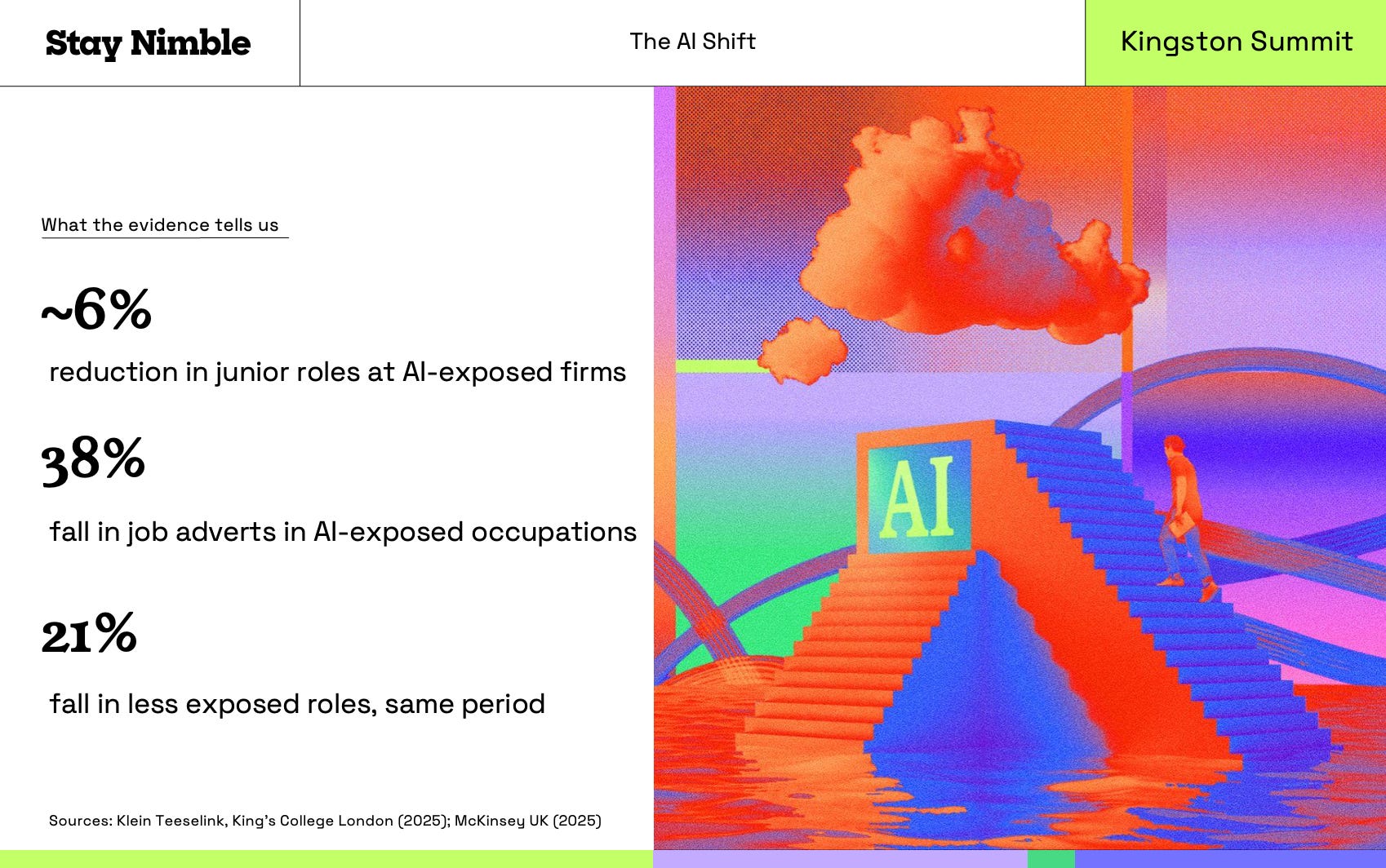
Now, the evidence is unclear about how much of this is directly caused by AI. A government assessment published last month noted that the patterns are suggestive but don’t yet establish AI as the sole cause. There’s a lot happening at the same time. Macroeconomics, geopolitics, post-pandemic restructuring, automation that was already underway.
But here’s the thing. It doesn’t really matter. Whether the disruption is driven by AI or by something else, the disruption is real and it’s happening. Work keeps changing. People keep needing to adapt. And they deserve support through that, whatever’s causing it.
So even if we’re not heading for an epidemic of joblessness, what we are likely heading for is an elevated state of disruption. Work changing more quickly. Roles evolving faster. People needing to adapt more often. We know this because it’s already happening.
And that currently puts the burden on individuals to navigate these regularly changing circumstances, often without much help.
If AI does turn out to accelerate that even further, you want the infrastructure already in place.
It’s not possible to waste money building resilience against a backdrop of already-endemic disruption, and one that the AI shift could accelerate.
When people ask for help
Those are big numbers. And it’s easy to stay in that analytical space. But behind every one of those numbers is a person.
When people sign up to Stay Nimble, we ask them an open question: “In a few sentences, tell us why you want to participate.” It’s deliberately open. It invites aspiration, goals, ambition.
That’s not what people write.
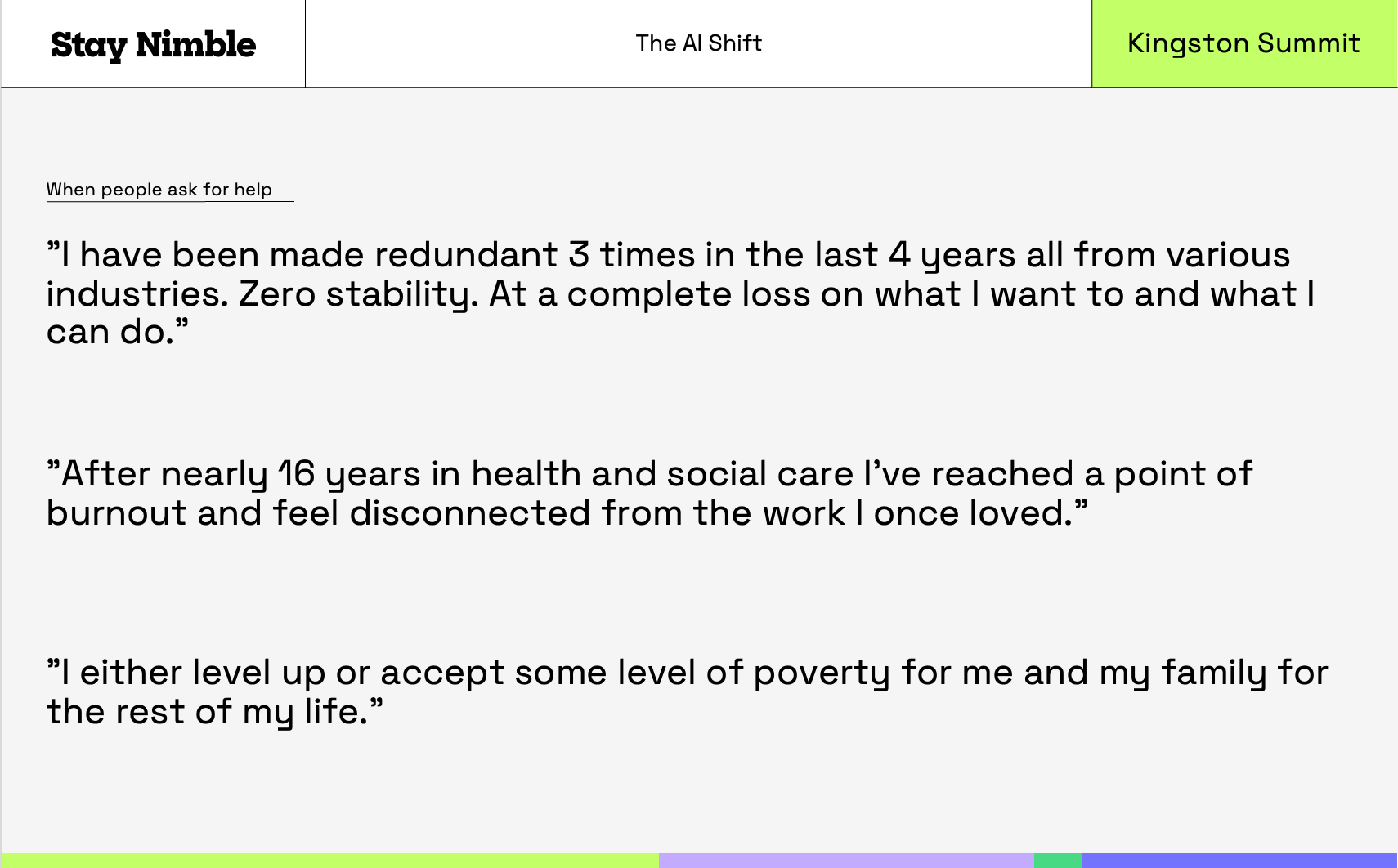
We analysed hundreds of intake responses. Only seven percent led with aspiration. Seven percent. The rest described challenges.
One person has been made redundant three times in four years across different industries. One did everything right for sixteen years and the work changed around them. One is staring at a cliff edge that has nothing to do with motivation or skills.
And the challenges compound. Someone might be burnt out, which has eroded their confidence, while caring for a family member and running out of savings. Someone else has a good degree and has applied for sixty jobs in twelve months and managed four interviews. Programmes designed to address one dimension can’t resolve that complexity, and nor should they.
But this is where I think our own operating system in employment and skills might need an upgrade.
Outcomes vs infrastructure
We all talk about employment outcomes, short term and longer term. Someone gets a job, we record an outcome, we close the case.
But the word “outcome” implies finality. It implies that the story is over. And if we’re honest, those endpoints were always fictions. We all know that the person’s journey didn’t end when they got the job or kept the job for 26 weeks. We just stopped counting because we are incentivised to deliver programmes. The system moved on. And the person carried on, often without support.
If the future of work is characterised by even more frequent transition, we can’t keep pretending that an employment outcome is the end of someone’s story.
An outcome-focused system treats the person who comes back in November as a new case. Infrastructure treats them as a continuation.
So the question that’s been on my mind is: if career transitions have always been permanent, and AI is likely to make them more frequent, why would we keep building systems designed to deliver endpoints? And could AI itself be part of a different kind of response?
Infrastructure, not a programme
What we’ve been building in Kingston is infrastructure. Not a programme. And the difference matters.
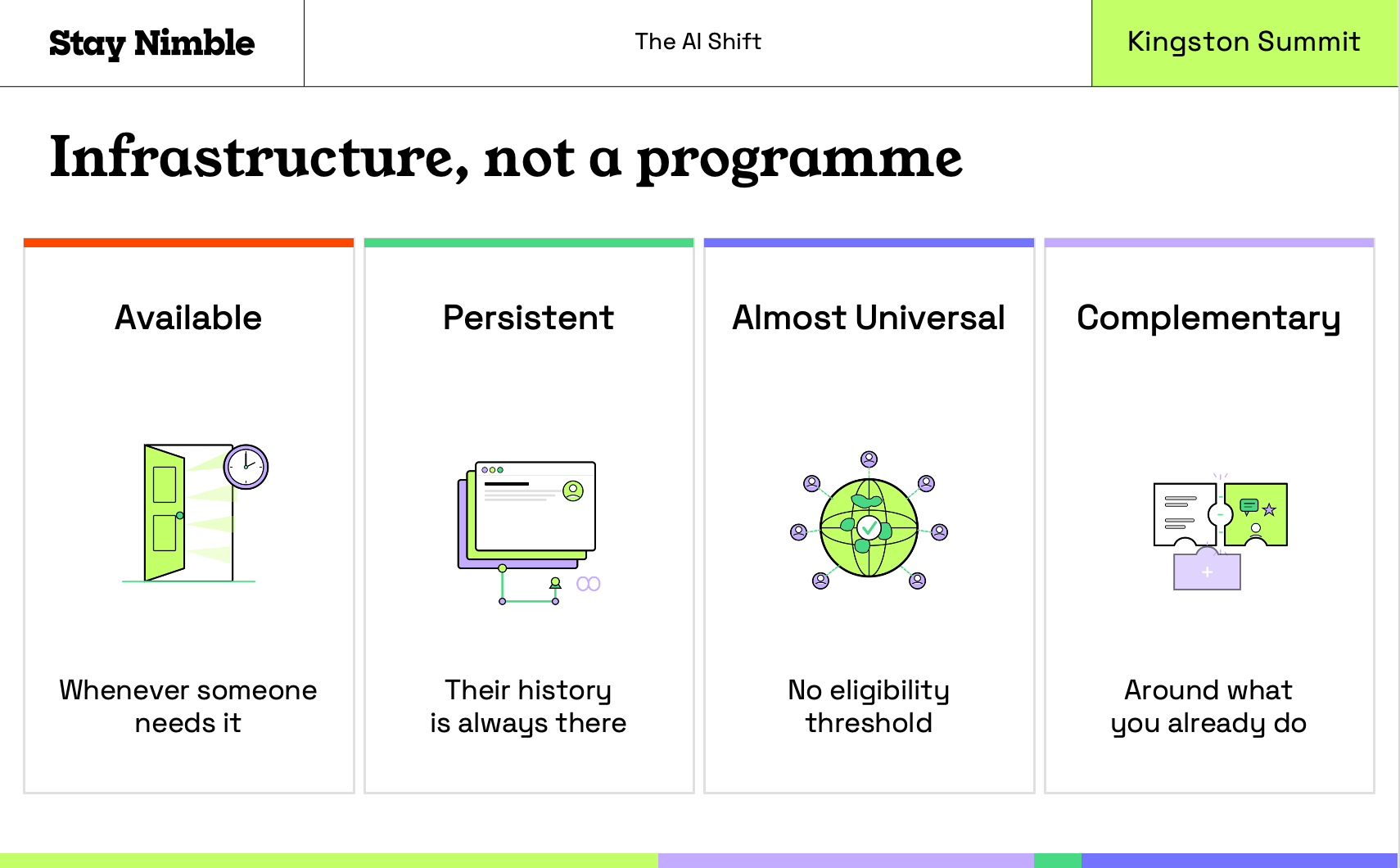
Available whenever someone needs it, easy to get access wherever they are. Persistent, so when someone comes back six months later, their history is there. They don’t have to re-tell their story. Almost universal, with no eligibility threshold except an income threshold. You don’t have to be unemployed or claiming benefits or living in the right postcode. And complementary.
Some of you reading this will be delivering Connect to Work and similar programmes. Some of you are running structured programmes with DWP contracts and compliance requirements and outcome targets. Those programmes exist for good reasons. When public money is being spent on intensive support for people with complex barriers, there needs to be accountability for that spend.
What we’ve built sits alongside that. It’s the layer that exists before someone qualifies for your programme. Or after your programme support ends. Sometimes between your appointments. For the people who need two hours of help, not twelve weeks of intervention. It’s not instead of what you do. It’s around it.
So let me show you what that looks like in practice.
Different doors, same building
Since 2022 we’ve launched five things in Kingston. Thrive Kingston, long-term personalised career coaching, that was the backbone. Launchpad Tech Start, focused on tech careers. Launchpad Green Jobs, supporting green economy transitions. That’s also had a run out with the SLP. Ask.Nim for RBK, our AI career assistant, embedded on the Kingston employment and skills support pages. And most recently, Career Allies to help build community capacity through practitioner upskilling in effective career conversations.
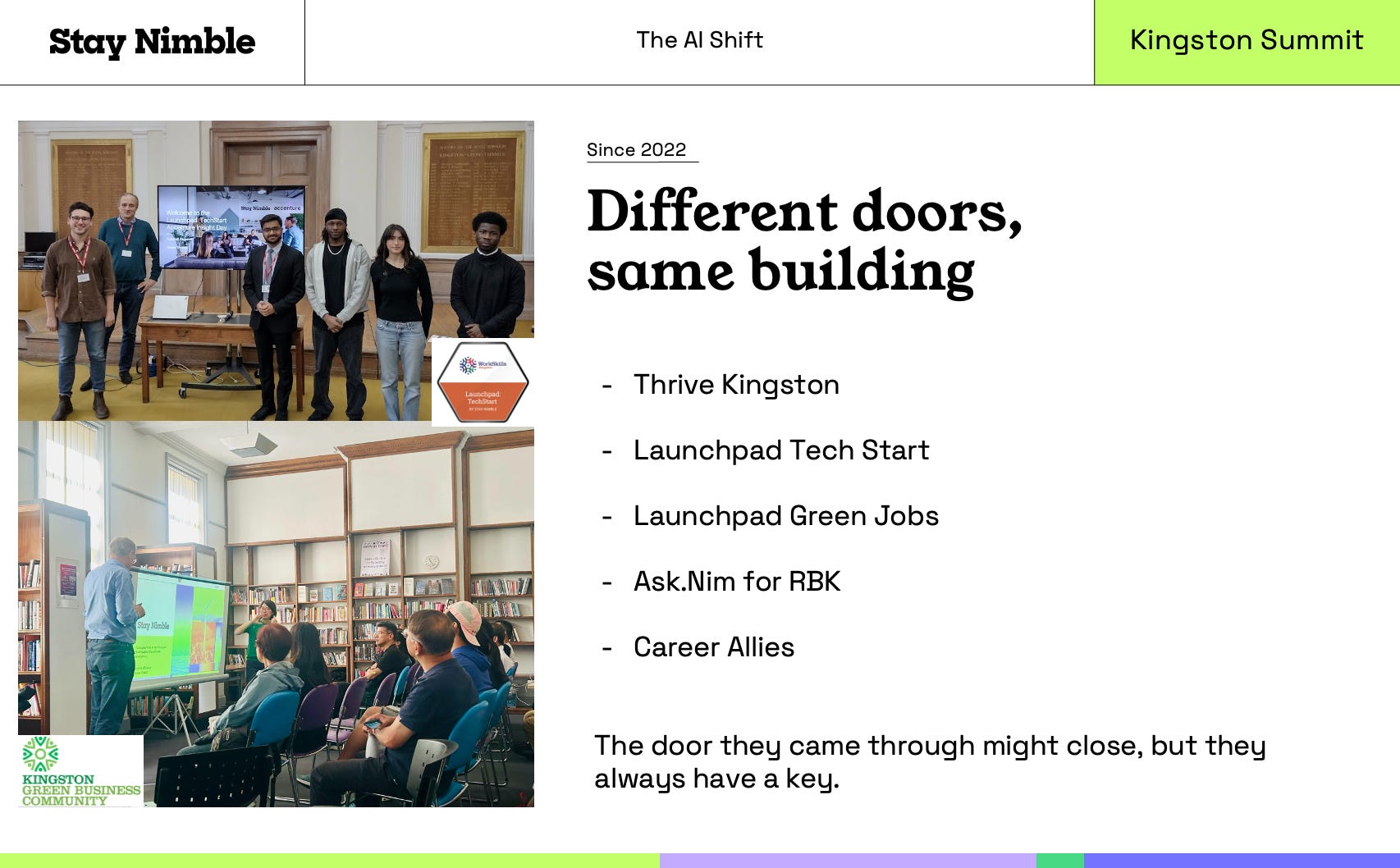
This all might seem like separate things, but we’ve actually been providing different doors into the same building.
Each was funded differently. Different pots of money, different initial eligibility criteria, different cohort names. But they all lead to the same place. A platform. A coach. A community of support. And everyone who comes through gets lifetime platform access.
The door they came through might close, but they always have a key.
Kingston since 2022
Here in Kingston, that’s 376 residents supported. 177 into work. £1.1 million in evidenced social value. Over 2,000 hours of coaching. Over 7,000 activities completed on the platform.
And all 376 still have access. Nobody lost it when funding changed. Nobody got cut off when a programme ended.
Blended funding
How does that work?
Corporates contribute through social value commitments in their supply chains, proving the commitments they made when they win contracts. Some contribute through direct giving. As a social enterprise, we reinvest our own trading surplus. The council invested through UKSPF. And some residents, once they’d used their funded sessions, bought more themselves once they had financial stability to do so.
No single source carries the whole cost, lots of organisations are contributing, and that’s how it sustains.
Total public sector investment over the last four years: £40k. That works out at £229 per employment outcome from the public purse.
And I want to be careful about that number, because it doesn’t mean we’ve figured out how to do the same thing cheaper. We’re not doing the same thing. The programmes that cost more are serving people with more complex barriers, providing more intensive support, operating within compliance frameworks that cost money to administer.
What this number tells you is that infrastructure-level support, blended funding, and technology can reach people at a scale and cost that programme funding alone never will.
Ask.Nim
So let me talk about the AI layer specifically, because I think this is the part of the conversation where it’s easy to get either too excited or too nervous, and I want to try and be neither.
We’ve been building AI-powered career support since 2019, so this isn’t new territory for us. And we’ve got a full year of data from Kingston now, specifically on a generative AI experience, free at the point of use and with no gated access.
Ask.Nim is our AI career assistant. It’s embedded on the Kingston support pages right now. It’s trained on the expertise of our CDI-registered and MHFA-qualified coaches. But it’s also trained on the services across the borough that have agreed to be included. So when someone asks for help, Ask.Nim doesn’t just give general career advice. It knows what’s available locally, and it can highlight resources and services based on the intent of the conversation. No single human adviser could hold all of that in their head and recall it instantly. The AI can.
A year of evidence
In 2025, Ask.Nim handled over 700 career conversations with individual residents on the Kingston pages. 19 languages. Arabic, Ukrainian, Turkish, Mandarin, Russian, Persian, Spanish, and more. We recorded a 93.5% success rate.
And 12% of those conversations were people asking about local support services, which tells you the borough knowledge is working. Only 1.9% was off-topic. People are treating this as a genuine service, not a novelty.
The 11pm moment
Think about the resident you spoke to at a community hub last Tuesday. You had a good conversation. They felt heard. They left with some next steps.
And then it’s 11pm that night, and they’re lying awake anxious about an interview the next morning. You’re not available. Your service isn’t open. There’s nowhere to go.
That’s the gap. And Ask.Nim can help to fill it. Not by replacing what you did at the hub or library, but by extending it. The conversation you started at 2pm can continue at 11pm.
Or think about the resident who doesn’t speak English as a first language. No interpreter needed. No waiting for a bilingual adviser. Someone can have a career conversation in their first language, right now, from home.
Or the person who isn’t ready to talk to a human yet. Maybe they’re embarrassed about their situation. Maybe they’re not sure they deserve help. Ask.Nim is a way in that feels safe. And when they’re ready for more, the infrastructure is there to connect them to a real person.
Or think about it from the practitioner’s side. A resident uses Ask.Nim before they come to see you. They arrive already knowing what services are available, already having thought through some of their options. Your conversation with them is more productive because Ask.Nim has helped with the groundwork. It handles the findable information, what exists, who’s eligible, where to go, so you can focus on the human work. The motivation. The confidence. The stuff that requires someone sitting across from them who actually cares.
AI and human
And I want to be clear about what it can’t do, too. It’s not a coach. It doesn’t have the emotional intelligence that a trained professional brings to a difficult conversation. It doesn’t know when someone’s holding back, or when they need to be challenged, or when what they really need is just to be heard. That’s human work.
And it doesn’t always get things right. It’s generating responses based on patterns, not looking things up in a textbook. That’s a real limitation and it’s one worth reminding ourselves about regularly, because once you understand that, you start to see why the human skills in this sector aren’t going anywhere. AI needs people using it to check, challenge, and contextualise what it produces.
AI has real limitations, and the people who need support the most deserve honesty about that. But here’s the other side of that honesty: a brilliant coach who’s only available to thirty people a quarter has limitations too. The question isn’t which one is better. The question is: what happens when you stop choosing between them.
So it’s not AI or human. It’s AI and human, each doing what they do best.
The combined system
And here’s what that looks like when you run both alongside each other. While Ask.Nim was handling those 700 conversations on the Kingston pages, we also had a coach in the community plus our remote coaches, funded through UKSPF and corporate social value.
In the same period, 180 people came through coaching. 51 employment outcomes. £290,000 in evidenced social value. The UKSPF-funded element delivered a 10 to 1 social value return on investment.
And Ask.Nim was actively directing people into that coaching when it recognised they needed more than AI could offer. Someone starts a conversation on the website at midnight. The AI helps where it can. But when the situation is more complex, when someone needs a real person, Ask.Nim connects them to a coach.
That’s not two things running side by side. That’s AI and human, each doing what they do best.
Ben’s story
I want to tell you about someone we’ll call Ben, because I think his story shows what continuity actually means for a person.
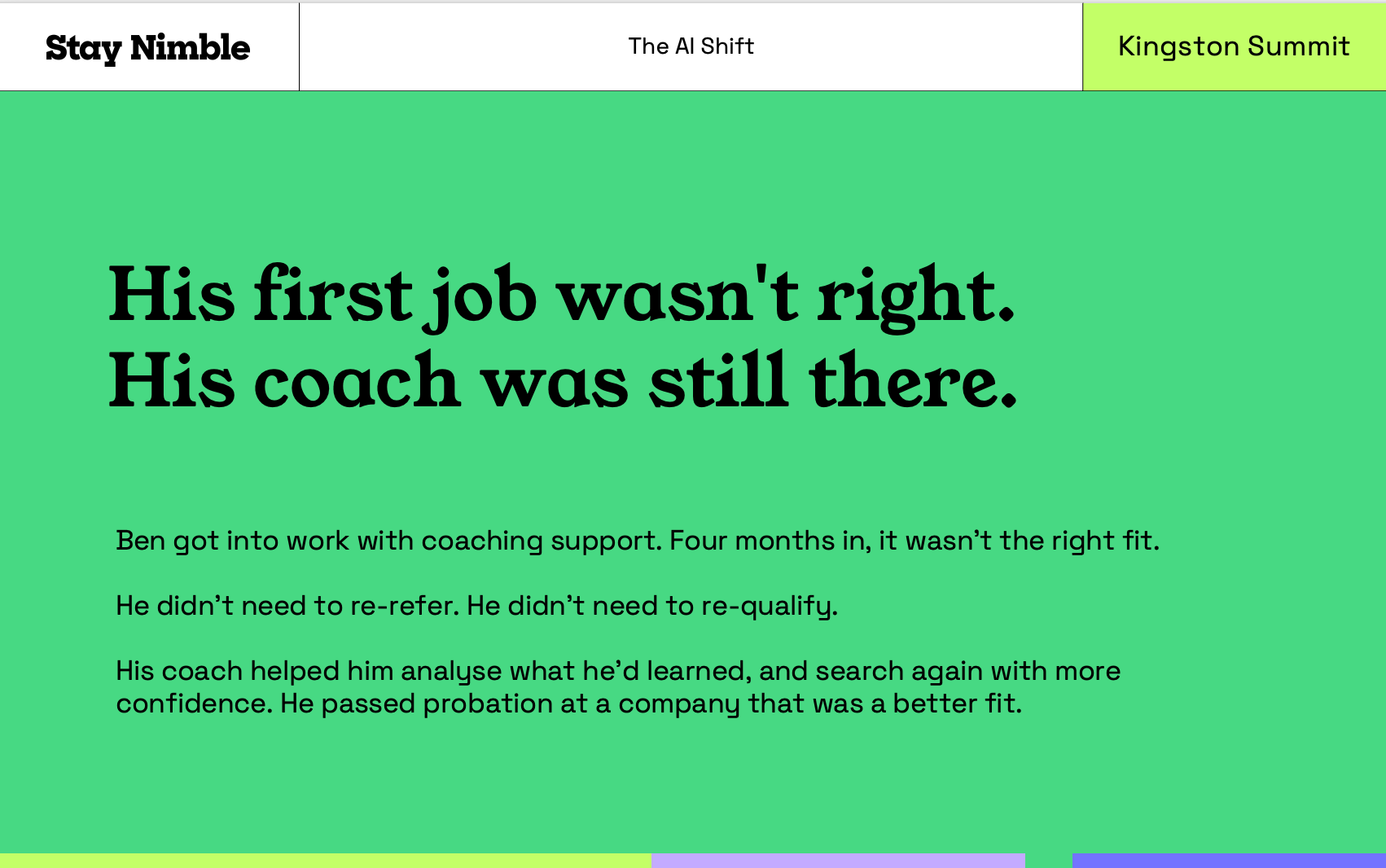
Ben had recently graduated. He had a Master’s degree. He was awaiting a formal assessment for ADHD, and he found interviews terrifying. His coach worked with him on preparation, reframed interviews as professional conversations rather than interrogations, and helped him find his confidence.
He got a job. Great. Outcome achieved. In a programme model, that’s the end of the story. Case closed.
But four months in, the role wasn’t right. And I want to be clear, that’s not a failure to us. That’s life. But if a programme had supported him, he might find that it had ended. He’d be back to the job centre, and starting from scratch with someone who didn’t know him.
In infrastructure, his coach was still there. They talked with him about what he’d learned. What worked, what didn’t, what kind of company he might thrive in. He searched again, with new clarity and renewed confidence. He found a better fit. He’s passed his probation. He’s enjoying his work.
That’s what continuity looks like. Not one outcome. A career. A normal life of change. And the infrastructure was there for the second chapter, not just the first.
Because our support isn’t tied to a programme timeline, people can use it on their own terms. And what we’ve found is that they come back. They step away. Life happens. They get a job, or they don’t, or something else takes priority. And then six months later, they’ve got an interview, or they’re facing redundancy, or they just want to think about what’s next. And they come back. The infrastructure remembers them. They don’t have to re-enrol. They just pick up where they left off.
But Ben’s story is particularly powerful because there was a person there. A coach who knew him, who understood his situation, who didn’t treat him as a new case when things changed.
And that got us thinking about where those conversations actually start. Because most of the time, the first person someone talks to about work isn’t a coach. It’s someone like you. A library worker who notices someone’s been coming in every day to use the computers. A housing officer who realises a tenant’s rent arrears are really about a job loss they haven’t talked about yet. A community hub volunteer who gets asked for help with a CV over a cuppa.
Those conversations are infrastructure too. They’re often the first moment someone feels seen. And if we’re serious about building for endemic transition, we can’t just invest in coaches and technology. We need to invest in the people who are already trusted, already embedded, already having these conversations.
That’s Career Allies.
Career Allies
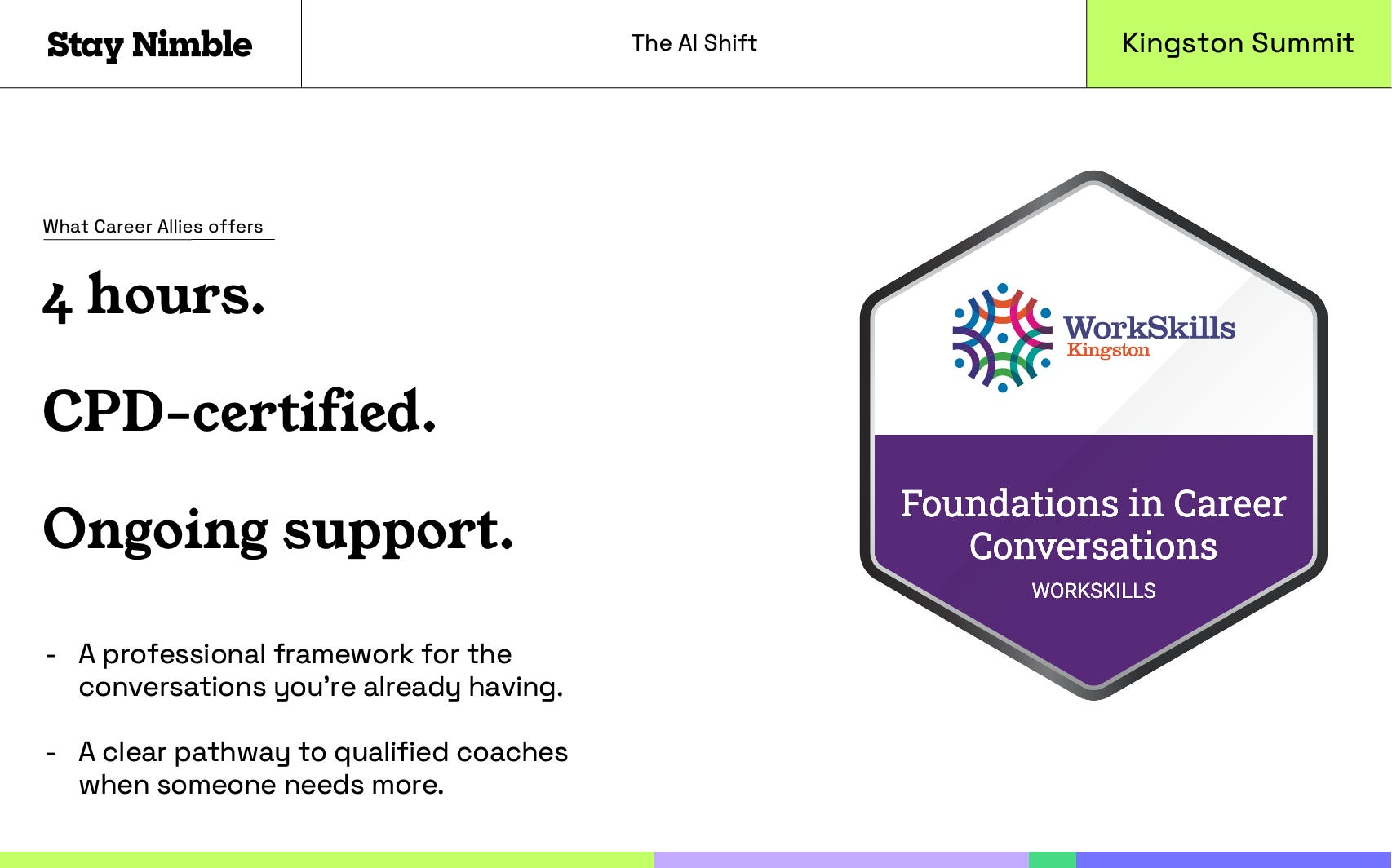
A professional framework for the conversations you’re already having. Not to turn you into career coaches, but to give you more confidence in those moments, and a clear pathway to qualified support when someone needs more than you can give.
It’s four hours of training, online and includes one hour in a group session led by a Stay Nimble coach. CPD-certified. Backed by CDI-registered professionals. There is ongoing support through learning circles so you’re not left on your own after the training ends. We’re building a community of practice that can extend way beyond Stay Nimble.
And this connects to something broader. Because when we talk about infrastructure for endemic transition, we can mean coaches and platforms and AI. But we also mean people. The colleague who notices someone’s struggling. The family member who gets asked for advice over Sunday lunch and doesn’t know what to say. The volunteer who can see someone needs help but isn’t sure how far to go.
Career Allies gives those people confidence. A framework for the conversation. The great questions to ask. And a clear pathway to qualified support when someone needs more than a good conversation can offer.
Kingston Adult Education commissioned the first cohort, and 50 people have got started across 18 organisations in the borough and in parts of South London.
Preparing for rising disruption
So let me show you how it all fits together. Because I started by asking whether we’re preparing for a wave or for some kind of permanent state of elevated transitions. And I think what we’ve built here in Kingston starts to answer the question of responding to rising disruption, or at least shows one way forward.
Four layers of infrastructure.
Career Allies for reach. Trained community workers in libraries, hubs, organisations across the borough. People who are already trusted, further equipped with the tools and confidence to help.
Coaches for depth. CDI-registered professionals for the conversations that need a skilled human. A tricky career decision. Confidence work. Interview anxiety. Someone at a crossroads who needs real expertise to help them think it through.
AI for scale. Ask.Nim, available 24/7, handling the volume that human teams can’t cover alone.
And the platform for continuity. The thread that connects everything. The thing that remembers. The place where progress lives. Opening doors through new programmes that the platform delivers. Giving people the key to a lifetime of support.
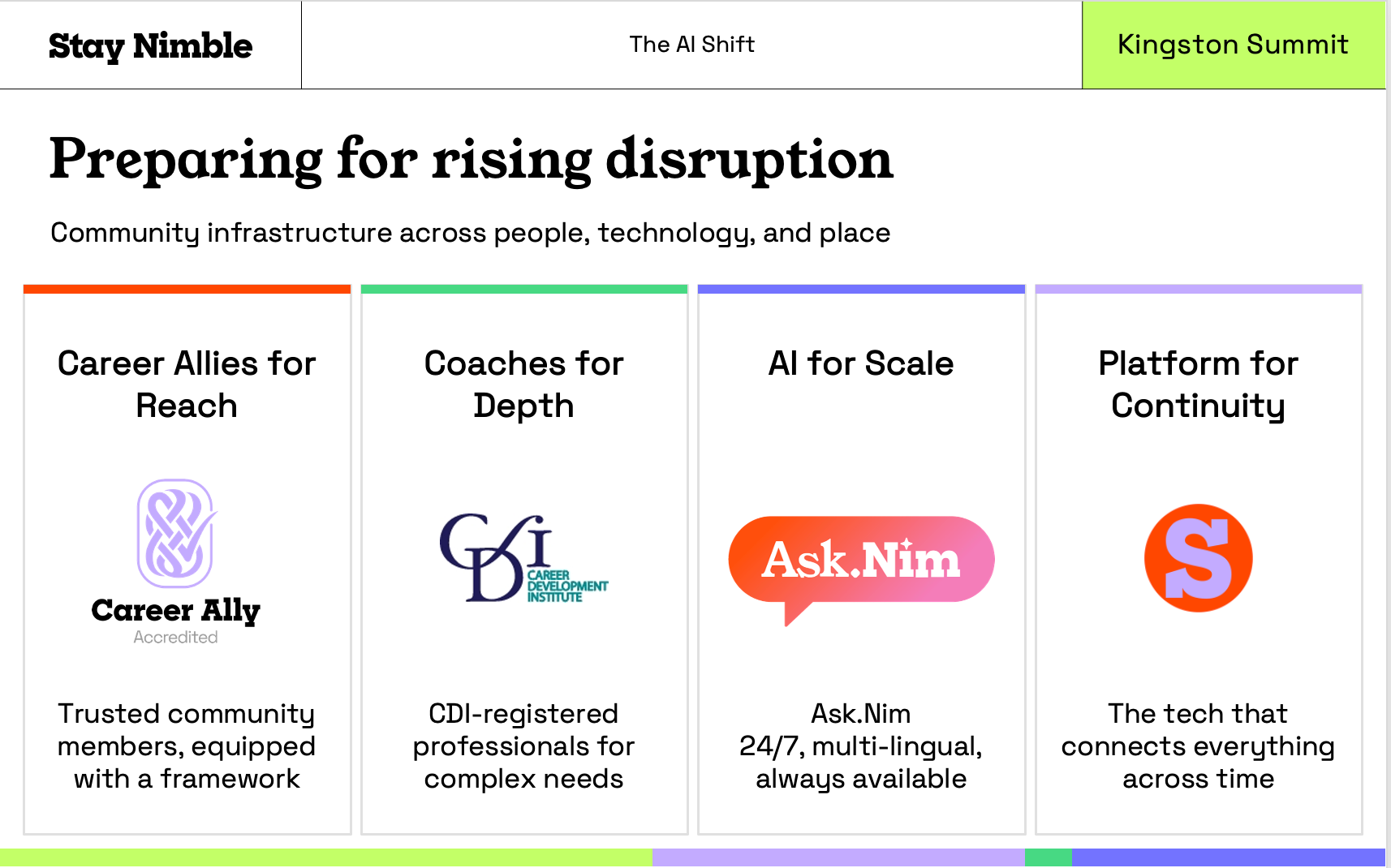
Each layer does something the others can’t. Together, they create lasting capacity that no single programme builds. And none of it depends on a single funding source. When one source reduces, others step in. When a programme ends, the infrastructure continues. We still report the outcomes for that programme window, but we don’t stop counting.
This starts with people. It’s extended by technology. And it’s anchored in communities. That’s how you build for endemic transition. Programmes as the way in. Infrastructure as the thing that’s still there when they come back.
I started by asking: what if this isn’t a wave to ride out, but a permanent change in how often people need to change direction?
And I think the honest answer is that the change already happened. The world of stable industries, single-employer careers, jobs for life, that was dismantled in the 1970s and 80s. Deindustrialisation, globalisation, the collapse of manufacturing. We’ve been living in an endemic state of career disruption ever since. And every decade adds a new force. Digitalisation. The gig economy. A pandemic. Now AI.
But we never built infrastructure for that reality. We built programmes. Start dates, end dates, outcome targets. Designed for a crisis, not a condition.
What we’ve been building in Kingston is a different kind of response. Infrastructure that starts with people, is extended by technology, and stays in place when funding changes. AI is part of that, but it’s one layer. The trusted relationships that practitioners bring are another. And they’re the layer that makes everything else work.
I’ll leave you with something someone wrote after using Stay Nimble.
“It gave me hope that there is so much support out there in case things don’t work out for me.”
In case things don’t work out for me. That’s what infrastructure sounds like in someone’s own words. Support that’s there not just for the crisis, but for whatever comes next. And the confidence that it’ll be there when you need it.